




Why Vero Beach Homes Run Out of Storage Space, and Where Your Things Should Go Instead
One comment we hear from new neighbors on 20th Street all the time: the house felt bigger when we bought it. Nothing shrank. What changed is that a Florida home stores things very differently from a home up north, and the places our customers counted on for years either are not there or are not safe for what they used to hold. Here at Storelocal Storage Vero Beach, this is how we walk people through what is really going on and how to decide what stays home.
At a Glance
- Most Vero Beach homes have no basement, and research from the Florida Solar Energy Center recorded attic air running about 40 degrees Fahrenheit hotter than outdoor air at the peak of a summer day, so we steer customers away from both of the storage spaces many northern households relied on.
- At Storelocal Storage Vero Beach on State Road 60, we offer drive up and indoor units for belongings that do not fit, or do not belong, in a Florida garage, attic, or condo closet.
The Storage Spaces Florida Homes Do Not Have
When we talk with customers who just relocated, the shortage almost always starts with what is missing from the floor plan.
No Basement
Up north, a basement quietly absorbs a household's overflow: holiday bins, the spare mattress, boxes of tax records, the kids' old toys. In Florida, basements are rare. Much of the state sits on sandy soil with water close to the surface, so homes here are usually built on a concrete slab at ground level. For families relocating from places like Ohio, New Jersey, or New York, that can mean losing hundreds of square feet of storage without realizing it until moving day.
Very Little Storage Built In
Many of the Vero Beach homes, villas, and condos our customers live in were designed around living space, lanais, and outdoor access rather than storage. Closets tend to be modest, the linen closet may be the only extra shelving, and a pool cage or screened lanai is outdoor living space, not a place to keep belongings. Customers coming from older ranch homes often tell us they have even less.
Why We Tell Customers the Attic Is Not the Answer
When the basement is gone, most people look up. We understand the instinct, but in Florida, the attic is the hardest place in the house to store anything well, and it is the part of this conversation we spend the most time on.
How Hot a Florida Attic Gets
We often point customers to work from the Florida Solar Energy Center at the University of Central Florida. Its researchers monitored side by side test homes through a Florida July and found that, under a standard dark shingle roof, the maximum attic air temperature during the peak summer hour was about 40 degrees Fahrenheit greater than the outdoor air temperature. On a typical Vero Beach summer afternoon, that puts an attic well into a range that is punishing for most household goods. Lighter and more reflective roofs ran cooler in that same research, but even then, an attic is not a controlled space.
What We See Attic Heat Do to Stored Items
When customers bring us boxes that spent a few summers overhead, these are the problems that come up most:
- Photos, documents, and paper: heating and cooling cycles curl, fade, and stick paper together, and humid nights make it worse.
- Candles, crayons, and anything with wax: these soften, warp, or melt.
- Vinyl records, DVDs, and plastics: heat warps them and makes some plastics brittle over time.
- Holiday decorations: lights, glass ornaments, and artificial trees with plastic parts wear out faster.
- Clothing and linens: fabric in cardboard boxes picks up odors and mildew as heat and humidity cycle.
- Electronics and batteries: heat shortens battery life and is hard on electronics in general.
The Access Problem
Even setting heat aside, attic storage in many Vero Beach homes means a pull down ladder in the garage ceiling, limited flooring across the joists, and a space nobody wants to spend more than a few minutes in for much of the year. Our customers tell us the same thing: what goes up tends to stay up, forgotten, until someone finally has to deal with it.
Your Garage Is Doing Three Jobs at Once
With no basement and a hard to use attic, the garage becomes the default storage room. That is where we see the squeeze most clearly.
Job One: Parking
In many Vero Beach neighborhoods, a covered spot in the garage matters. It keeps your car out of summer sun and afternoon downpours and protects it during storms. Many homeowner and condo associations also have rules about where vehicles can be parked overnight, which makes the garage even more important as a parking space.
Job Two: Laundry, Workshop, and Utility Space
In a lot of the Florida homes our customers describe, the washer and dryer, water heater, and sometimes the air handler share the garage. Add a workbench, tools, and yard equipment, and much of the wall space is already spoken for.
Job Three: Hurricane Season Supplies
The Atlantic hurricane season runs from June 1 through November 30, and we always encourage customers to keep shutters or panels, a generator, fuel cans, water, and supplies ready to use. Those items need to be reachable fast, so they deserve prime garage space during those months rather than being buried behind boxes.
When all three jobs compete, the car usually loses first, and the garage turns into a storage unit that also happens to have a washing machine in it. That is often the moment people call us.
Condos, Villas, and Community Rules
A large share of our customers live in condos, villas, and communities with an association, and these homes come with their own storage limits.
Limited Private Storage
Condo units may come with a small storage closet or a cage in a shared area, if anything at all. Villas often have a one car garage or a carport. For customers downsizing from a larger house, we find the math rarely works out without somewhere else to put things.
Rules About Sheds and Outdoor Storage
Many associations restrict or prohibit backyard sheds, outdoor storage boxes, and items kept on balconies or lanais. We always suggest checking your association documents before buying a shed. For many of our customers, the simpler answer is keeping outdoor gear off the property altogether.
How We Help Customers Decide What Stays and What Goes
Once you understand why space runs short, the real question is how to sort your belongings. This is the simple split we use when we talk it through with customers.
Keep at Home
- things you use every week
- hurricane supplies during storm season
- everyday tools and yard equipment
- important documents you may need to grab quickly in an emergency
Good Candidates for a Storage Unit
- holiday and seasonal decorations you use once or twice a year
- furniture you are keeping for a future home or for family
- extra dining chairs, guest beds, and pieces you bring out for visitors
- seasonal sports and hobby gear, like golf travel bags, extra bikes, and camping equipment
- keepsakes, boxed books, and memorabilia that would otherwise go into the attic
- business inventory, samples, and records if you work from home
For many of the households we work with, moving just the seasonal and occasional items out of the garage is enough to get the car back inside.
Estimating How Much Space You Need
Customers often ask us for a size before they know what they are moving, so we suggest a quick walk through first. Stand in the garage and set aside only what you touch less than once a month, then do the same with anything headed for the attic. Most people are surprised by how much of the pile is seasonal.
As a rough guide, the holiday bins, spare chairs, and hobby gear from a typical crowded garage usually fit in a 5x10. If you are also holding a bedroom set, a sofa, or boxes from a recent move, a 10x10 is a more realistic starting point. Customers keeping most of the furniture from a larger northern home for a future house or for family often need a 10x15 or 10x20. Stack boxes high, keep a narrow aisle so you can reach the back, and put the things you will want first near the door. If you are unsure, our team can look at your list with you and recommend a size before you commit.
Which of Our Units Fits What You Are Moving Out
At our facility, the right unit usually comes down to what you are clearing out and how often you will come back for it.
Drive Up Units for Garage Overflow
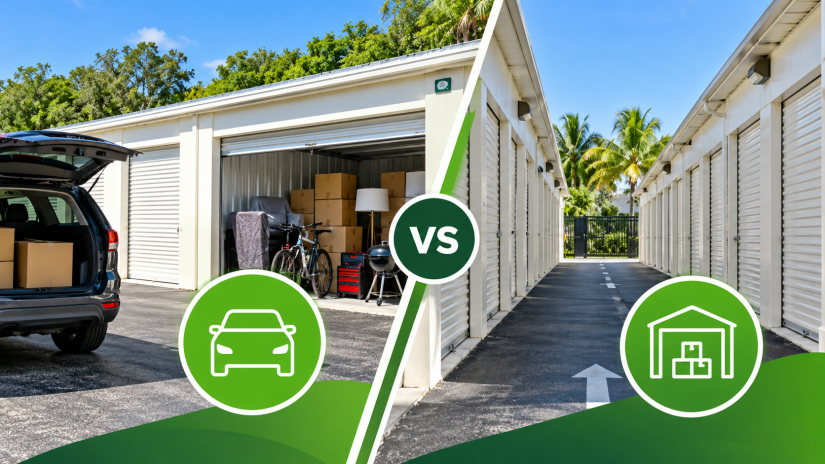
If you are clearing a garage, most of what you bring us will be bulky: furniture, bikes, bins, and tools. Our drive up storage lets you pull your vehicle right to the roll up door and unload a few steps away, which makes one big clean out much faster.
Indoor Units for Attic Refugees
If you are rescuing boxes, keepsakes, and holiday decorations from the attic, we usually recommend an indoor unit with interior access, since those items are mostly boxed and you will visit only a few times a year. Our personal storage options cover both approaches.
How We Suggest Packing, Either Way
Wherever your things end up, we recommend sealed plastic bins, completely dry items, and furniture raised off the floor on pallets or shelving rather than cardboard on bare concrete.
If You Work From Home
A spare bedroom that became an office and a garage full of inventory is a combination we see often in Vero Beach. Our business storage gives you a place for stock, records, and equipment so your house can go back to being a house.
Getting Your Space Back
Vero Beach homes are not badly designed. They are built for Florida weather and a lifestyle where outdoor living matters more than a basement ever could. The fix we recommend is to stop asking the attic and the garage to do jobs they cannot do well, and to give seasonal and occasional belongings a better home.
If the garage is the room you are most eager to reclaim, our article on why self storage beats garage chaos for holiday décor is a good next read, especially with the holidays coming up. When you are ready to clear some space, you can reserve a drive up or indoor unit online at Storelocal Storage Vero Beach, or learn more about Storelocal Storage and the communities we serve. Our team on 20th Street is glad to help you figure out how much space you actually need.


