



Where Oklahoma City Businesses Keep Files, Records, and Extra Inventory Safe Using Off-Site Storage
Paper files, archived records, product samples, and extra inventory have a habit of taking over useful workspace. A filing room fills up, boxes start stacking along office walls, or valuable stockroom space becomes occupied by materials employees only need a few times a year.
For businesses that need to keep those items without keeping them underfoot, off-site records storage Oklahoma City can provide a practical middle ground. Storelocal Film Row gives local businesses a place to store records, supplies, and approved inventory outside their primary workplace while keeping them accessible within central Oklahoma City.
Why Keep Business Records Off-Site?
Not every document needs to sit within arm's reach of an employee.
Companies often retain paperwork for operational, financial, historical, or internal business reasons. Even after a file is no longer part of daily work, the business may still need to keep it available for future reference.
Common examples include:
- Closed project files
- Accounting and tax records
- Past contracts and agreements
- Employee-related paperwork
- Vendor documents
- Printed reports
- Property or equipment records
- Marketing archives
- Photographs and printed media
Moving older material to a dedicated storage space can free cabinets, closets, conference rooms, and back offices for active business use.
The important distinction is organization. Off-site storage is much more useful when a company treats it as an archive rather than a place to put unmarked boxes.
Climate Control Matters for Paper and Photos
Paper may seem durable, but long-term exposure to changing temperatures and humidity can affect it.
Heat and moisture can contribute to warping, discoloration, ink deterioration, and other changes over time. Photographs, printed marketing pieces, binders, and other paper-based materials can also be affected by repeated environmental swings.
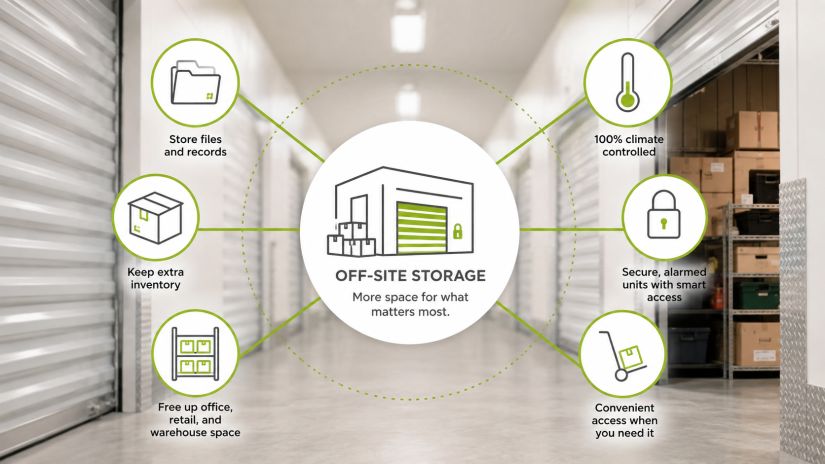
Storelocal Film Row offers 100% climate-controlled units. Climate control helps reduce exposure to large temperature and humidity fluctuations, which makes it particularly relevant for businesses storing paper files, photographs, and similar materials.
It is not a guarantee that stored documents can never be damaged. Good packing, organization, and appropriate containers still matter.
Pack Records for Long-Term Storage
A few basic habits can make a records unit significantly easier to manage:
- Use sturdy, consistently sized file boxes when possible.
- Label boxes on more than one visible side.
- Keep files off the floor using shelving or another appropriate storage setup.
- Group records by department, year, client, or record type.
- Create an inventory showing what is stored in each box.
- Avoid packing documents while they are damp.
- Leave frequently requested files in an easy-to-reach area.
For paper file storage Oklahoma City businesses can also consider a simple check-in and check-out process so employees know when archived material has temporarily left the unit.
Control Who Accesses Stored Records
Business files often contain information that should not be casually accessible to every employee.
That does not mean a storage facility automatically satisfies a company's legal, regulatory, or industry-specific recordkeeping requirements. Businesses should determine their own obligations before choosing where and how sensitive records are stored.
What off-site storage can provide is better physical organization and more intentional access.
Storelocal Film Row uses Nokē smart entry, which provides a digital phone key and access logs. For a company using a unit primarily for records, those logs can help track who accessed the storage area and when.
Spaces are also individually alarmed, and the facility has gated entry, fire sprinklers and detectors, and on-site management.
What About Medical Records?
Some organizations may search for storage for medical records Oklahoma City because older files are occupying too much office space.
Medical records require particular care because healthcare organizations may be subject to privacy, retention, disposal, and access requirements. Storelocal Film Row does not make compliance claims for medical record storage, so any healthcare business should evaluate its own requirements before moving protected or regulated documents off-site.
From a physical-storage perspective, climate-controlled space and controlled access can still be useful considerations for paper records. They should be viewed as facility features, not as substitutes for a business's legal or compliance procedures.
Off-Site Storage Is Useful for More Than Paperwork
Files are often only part of the space problem.
A business may have old records occupying one wall while extra merchandise, promotional materials, packaging, or event supplies occupy another. Keeping these lower-use items in a separate unit can make the company's main workplace easier to operate.
Businesses commonly use off-site space for:
- Overflow inventory
- Product samples
- Printed marketing materials
- Event supplies
- Seasonal merchandise
- Packaging materials
- Branded signage
- Office supplies purchased in larger quantities
- Archived displays or promotional materials
This is where document storage for Oklahoma City businesses can become part of a broader space-management strategy rather than a standalone filing solution.
Keep Extra Inventory Separate From Daily Stock
Not every product needs to occupy prime shelving or stockroom space.
An Oklahoma City retailer, service company, or other local business may have inventory that is still useful but does not move frequently enough to justify keeping it in the main work area. Separating active stock from overflow stock can reduce clutter and make routine inventory management easier.
A simple system might divide stored items into:
- Current records — documents that are referenced regularly.
- Archived records — files that need to be retained but are rarely accessed.
- Active overflow inventory — additional stock likely to be needed soon.
- Seasonal inventory — merchandise or materials needed at specific times.
- Marketing and event materials — signs, displays, printed pieces, and supplies used periodically.
Each category can then have its own labeled area inside the unit.
Build a Records System Before Moving Boxes
A storage unit should make information easier to manage, not harder to find.
Before moving records off-site, assign each box a unique number or identifier. Keep a separate inventory that shows the box number, contents, relevant date range, and where the box sits within the unit.
For business record storage OKC, even a basic spreadsheet can be enough to prevent employees from opening ten boxes to locate one file.
It also helps to establish clear internal rules for:
- Who can retrieve records
- Who maintains the inventory
- How retrieved files are logged
- When records are reviewed
- How obsolete material is handled
- Who decides when an item should return to the office
Those procedures remain the responsibility of the business, but having a dedicated storage area can make them easier to follow.
Keep Business Storage Close to Central Oklahoma City
Off-site storage becomes less useful when retrieving one box turns into a long trip across the metro.
Storelocal Film Row is located at 1711 NW 5th St in the Film Row district, with access from central Oklahoma City areas including downtown OKC, Midtown, Automobile Alley, Bricktown, and Classen Blvd.
For businesses that periodically need to retrieve records, inventory, or marketing materials, having commercial storage for business materials nearby can make off-site organization more practical.
Touchless online rental is available, and Storelocal Film Row also provides on-site management for businesses that need assistance at the facility.
Give Your Records and Inventory a Defined Place
Keeping every file, box, and piece of overflow inventory inside the workplace can make valuable commercial space harder to use.
A dedicated off-site unit gives businesses a clear place for archived records and lower-use inventory while keeping active offices, stockrooms, and work areas focused on current operations. Climate-controlled units, Nokē smart entry with access logs, individually alarmed spaces, gated entry, and on-site management can all be useful factors when deciding how to organize those materials.
Call Storelocal Film Row at (405) 445-0798 to check current unit availability and discuss your business storage needs.


